
Money Makes Me Feel ___: What Your One-Word Answer Reveals
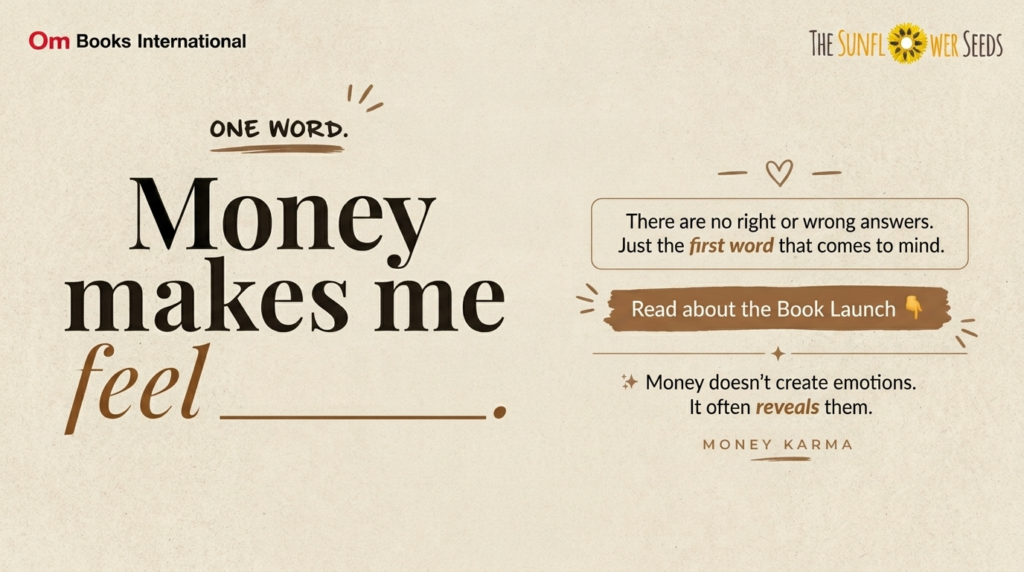
Try it right now. Don’t think about it. Don’t edit it. Just finish the sentence:
“Money makes me feel ______.”
Anxious? Free? Guilty? Powerful? Ashamed? Safe?
Whatever word landed first is rarely random. It’s usually the residue of a hundred small moments – a childhood memory of a parent counting bills at the kitchen table, a first payslip, a loan you’re still paying off, a purchase you regretted, a gift you couldn’t afford to give. Money moves through almost every relationship, every decision, every plan for the future – and yet most of us have never actually stopped to ask what it makes us feel.
Money Doesn’t Create Emotions. It Reveals Them.
That’s the idea at the heart of this exercise, and it’s also the idea at the heart of Money Karma by Moona Ssahni. The book’s central argument is a quiet but important correction to how most of us think about money: we tend to treat our financial anxieties, our impulsive spending, our inability to save, or our discomfort talking about salary as problems with money. Ssahni’s premise is that these are rarely problems with money at all – they’re problems the money is simply surfacing.
Fear of scarcity often isn’t really about the bank balance. Guilt over spending often isn’t really about the purchase. The emotional charge was there long before the transaction – money just happened to be the mirror.
Why One Word Says So Much
Psychologists who study financial behaviour call this our “money script” – an unconscious belief about money formed early in life, usually inherited rather than chosen, that quietly runs in the background of every financial decision we make as adults. Someone who grew up hearing “we can’t afford that” may associate money with restriction and feel a flash of guilt every time they spend, even when they can clearly afford it. Someone who saw money used as a reward or a way to keep score might associate it with self-worth, and feel a dip in confidence when their income drops or a peer earns more.
None of this shows up when you look at a bank statement. It shows up in the one word you reach for when someone asks how money makes you feel.
That’s what made this such an interesting question to put out into the world – not because there’s a “correct” answer, but because the range of answers says something collectively true: everyone’s relationship with money is shaped by a story, and most of us have never read that story back to ourselves.
What People Are Saying
When we asked our community to complete the sentence, the responses ranged from “free” and “empowered” to “anxious,” “trapped,” and “guilty” – sometimes from people with very similar financial circumstances. Two people earning the same salary can have completely different emotional relationships with money, because the emotion was never really about the number.
That gap – between what your bank balance says and what your gut says – is exactly the territory Money Karma sets out to explore.
Read the Rest of the Story
If your one word surprised you, that’s usually a sign it’s worth paying attention to. Money Karma digs into where these instinctive reactions come from, and how to start separating what money actually is from what it’s been made to represent.
We celebrated the launch of Money Karma by Moona Ssahni on 23rd July, 4 PM onwards, at Om Book Shop, Ambience Mall, Gurgaon. The book is now available — grab your copy : Amazon
What’s your one word? Drop it in the comments on our Instagram post — we’d love to know.
If you’re looking for expert help tailored to your genre, audience, and personality, The Sunflower Seeds offers everything from media outreach and blog strategy to YouTube content and SEO marketing for authors. We’ve helped several emerging voices find their tribe – and we’d love to help you, too.
Ready to market your book the smart way?
Avoid the rookie errors – embrace strategy, storytelling, and support.
Because great books deserve great readers