
How to Market a Business Book (Without Turning It Into a Sales Pitch)
Business books sell differently from every other category, because the author’s credibility is the actual product being marketed – the book is just the delivery format. Readers aren’t buying a story; they’re buying access to how a specific person thinks, and that changes almost every decision that follows. A novel can be marketed on mood and premise. A business book is marketed on trust – does this person’s thinking hold up, is it worth an hour of a reader’s attention, would it change how they approach their own work.
That’s also why so many business book launches underperform despite genuinely useful content. The marketing gets treated like a countdown to publication day – a cover reveal, a few announcement posts, maybe a launch party – when the real work is building a reputation for sharp thinking well before there’s a book to sell. Every decision below, from the ideas an author shares publicly to the platforms they choose, should be built around demonstrating expertise rather than announcing a product. Get that sequence right, and the book essentially sells itself to an audience that’s already decided the author is worth listening to.
Own One Idea, Not Ten
Before a single promotional post goes out, the book needs a one-sentence answer to “what’s the one idea a reader repeats to a colleague after finishing this?” Business books that break out tend to own a single sharp concept rather than covering a topic exhaustively. Vague, everything-for-everyone positioning is the most common reason a good book fails to find its audience – and it’s worth locking down months before launch, not after.
LinkedIn Over Instagram
When you market a business book, LinkedIn does the heavy lifting that Instagram does for other genres. Value-led posts, frameworks pulled directly from the book, and testimonials from founders or executives build the authority that converts readers into buyers. This works best when it starts well ahead of launch – six to twelve months isn’t unusual – so there’s already a warm audience of people following the ideas before they’re asked to buy anything.
Podcasts Convert Better Than PR
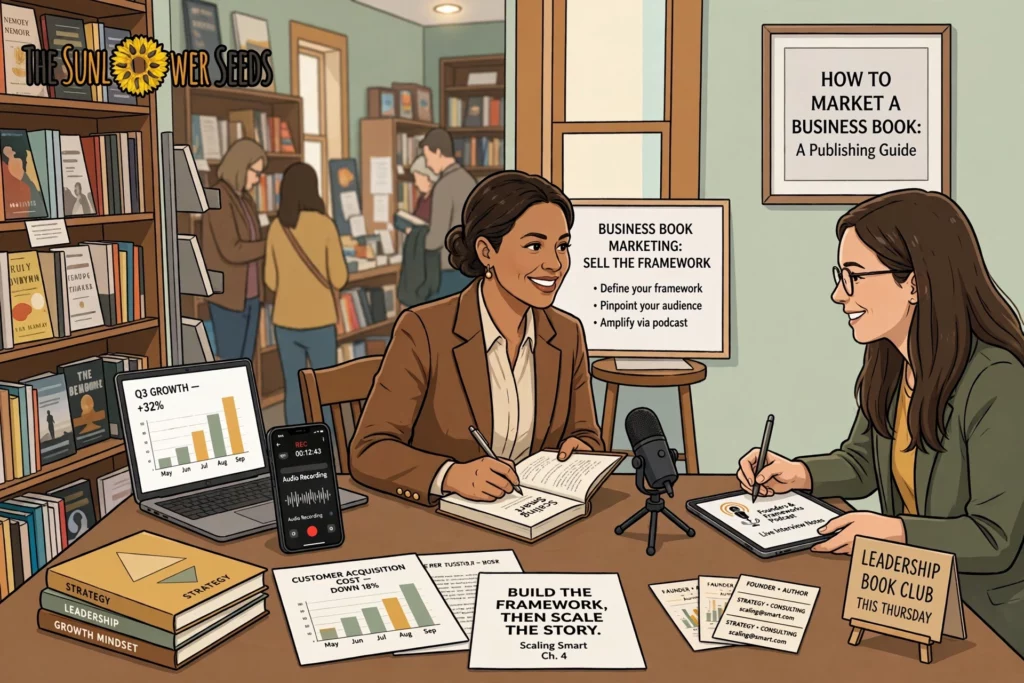
Business readers tend to buy after hearing an author think out loud, not after reading a press mention. Podcast guest spots and speaking engagements consistently outperform traditional press placements for this genre, because they let a reader sit with the author’s reasoning for thirty or forty minutes instead of two column-inches.
Turn the Book Into Standalone Content
Case studies and data points from the manuscript work well repurposed as LinkedIn carousels or newsletter sends in the weeks leading up to launch – they let readers sample the author’s thinking before committing to the full book. The same material can later become a talk deck, a short video, or a follow-up blog series, so nothing in the manuscript is used only once.
Launch Day Is a Spike, Not the Campaign
It’s tempting to pour everything into publication week. But the more durable wins – a mention in a trade publication, an invite to speak at a conference, a bulk order from a company running an internal training – tend to land in the ninety days after launch, not during it. Business books also have a sales channel most other genres don’t: organisations buying copies in bulk for teams, onboarding, or client gifts, which is worth planning for well before the book is even printed.
The Indian non-fiction market gives this some context: trade non-fiction – the category business books sit in – accounts for well over half of both volume and value in the country’s overall trade book market, according to Nielsen BookScan data, making it the single largest genre by a wide margin. That’s a large, attentive audience, but also a crowded one – all the more reason positioning and a real pre-launch following matter more than launch-week noise.
Quiet, consistent groundwork – a following built early, ideas tested in public before the book arrives, and a plan for the quarter after launch – tends to do more for a business book than any single announcement ever will.
If you’re looking for expert help tailored to your genre, audience, and personality, The Sunflower Seeds offers everything from media outreach and blog strategy to YouTube content and SEO marketing for authors. We’ve helped several emerging voices find their tribe – and we’d love to help you, too.
Ready to market your book the smart way?
Avoid the rookie errors – embrace strategy, storytelling, and support.
Because great books deserve great readers